Monday, January 23, 2017

Mystery Hunt 2017: The One Built For Us

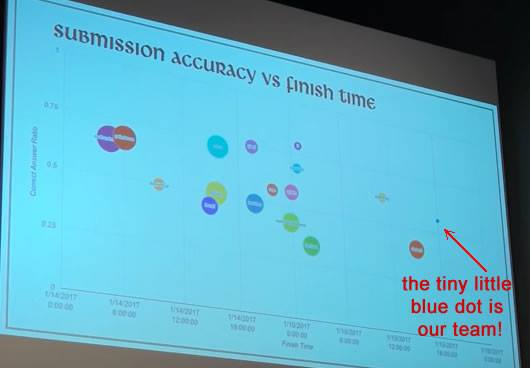
Last weekend I participated with in Mystery Hunt, an annual giant word puzzle competition hosted by MIT on behalf of the team Left as an Exercise for the Reader.   Despite being much smaller (officially 35, unofficially who knows) than almost every major competitive team, we, for the first time ever, got to the end.  There are some spoilers ahead, but not all that many, given the large portion of Hunt I barely saw. There is also probably song lingo that will be utterly meaningless to you, if you are not familiar with this type of thing.

To give some background, Mystery Hunt started in 1981 as a small event, one person creating a page of puzzles for MIT students solve.  It grew slowly for a while; one member of our team last won Hunt in 1991 with a team of 6. As it grew though, it became an arms race where puzzle writers tried to make larger and more difficult hunts to counteract ever growing teams and advancing technology.  

I first hunted in 2010 and have done it every year since then except one.  Mystery Hunt was my first puzzle event of any kind, and it was generally impossible.  I’m not sure if I contributed anything of value that year, and mostly felt dumb.  I’ve gotten better since then, but not enough that I don’t find Mystery Hunts to be mainly overwhelmingly difficult, with occasional satisfying moments of making a minor impact.  The worst one was 2013 where the designers underestimated the strength of their play testers, and decided to make their puzzles even harder with puzzles like this one.  That Hunt lasted 75 hours and required lots of free answers and hints to end it at all.  2014 and 2015 had better balance, but 2016 was written by another large team, and was rough on smaller squads.  I have found I have generally enjoyed smaller events like BAPHL and DASH, where I’m hitting my head into a desk less often.
Setec, this year’s host, is small for a winning team clocking in at around ~50.   They have a few wins in the past, but for a while were determined not to win.  If they got close, they started drinking more.  Eventually they forgot how painful writing a Hunt is, sobered up, and won last year.  They brought with them a new philosophy in writing this Hunt -- not-impossible puzzles are even more fun than impossible puzzles.  They wanted to make it challenging for the top teams too, but wanted to make sure everyone had fun, and that more teams got to progress to major milestones.

After partaking in my annual tradition of getting on the MIT Campus, I saw a cute opening sketch of a role playing game themed Hunt.  The first puzzle I worked on was Pic of the Litter, because I could identify pictures of objects and put it in a fill-in grid.  It was pretty straightforward and a nice start to the the Hunt.  Then I started on Hexed Adventure, a text adventure game.  Let’s see: desert to my left, mountain to my right, hills in the distance…  hmm that sounds suspiciously familiar.  I then spent most of the next 8 hours with a partner roaming around a Catan board.  The puzzle wasn’t hard per se, but it had a lot of steps and a mountain of text as you progressed to the actual solvable puzzle part.  We got stuck a couple times, most frustratingly missing where to get WD40 from, but for the most part we progressed steadily.  The solving part was also a little more challenging than it could have been, since we forgot wood could be lumber, and ended up with something that looked like it should give us an answer but wasn’t.  Still it was an incredibly fun puzzle, and I’d recommend giving it a try if that sort of thing appeals to you.  There was another puzzle with a mock BGG page, so for a while I was working on two board game related puzzles at once.  It was great.  

We were also visited by an economist, transfixed as Bob Barker, and played some Price is Right until we identified the exact price of a cup of our color pencils.   I nibbled at a few more puzzles afters, but didn’t make much progress.  My final useful contribution was standing behind someone who got stuck.  He proceeded to tell us what he done thus far, tell us what he just did that didn’t work, realize that in fact it did work, corrected a minor error and solved the puzzle.   Nice to know hovering works.  I left for the evening while we were trying to figure out how to use semaphore on elements in a circular periodic table.*

*Spoiler-- you don’t

Saturday morning, I came in knowing Death and Mayhem had already found the coin, winning the Hunt, which was a good sign for us getting far.   I bounced around a bit, trying to get back into the swing of things, not all that successfully.   Someone mentioned there was a Fantasy Baseball puzzle, Special OPS, so I joined in on that.  It involved figuring out the real components of fake stats.  We tried it both manually and through a program someone built, but we never had any success.  I spent a lot of time trying to make the numbers work, but they wouldn’t.  I felt bad for striking out on a puzzle that should clearly be in my wheelhouse, but it turns almost no one successfully solved it.  There were less impossible puzzles than normal, but there still was some, and even reading the solution, left me utterly confused.

Feeling dejected, I picked up a children’s book that we had received entitled The Puzzle at the End of the Book, modeled after the Sesame Street Book, The Monster at the End of the Book.  It was a small book, so I figured that it shouldn’t take too long to solve.  Turned out there were a whole lot of puzzles hidden in there.  It was a really cool puzzle in that everyone who looked at it found different things.   If you haven’t done any puzzle competitions, but the idea sounds interesting to you, this is a really good puzzle to start with.

We celebrated our team’s birthday at noon.  It was was our 10th entry into the Hunt.  We had tiaras and cake and invited some teams over including our neighbors, IIF, and Setec.  It went well, we even had an appropriate amount of food unlike last year, when we had to call HQ with an emergency cookie problem.  The only misstep was we accidentally sent Palindrome a blank invitation, which they assumed was a puzzle and proceeded to try to solve.  Palindrome finishes the Hunt early though, so we were just giving them something else to do.

I also made my biggest meta contribution that day, determining that the Crafty Criminal meta involved actually playing Mastermind.  Before I had to time figure out how that could work though, someone else discovered the black and white letters, and an offsite supersolver submitted a correct answer.*  Still, I feel good about that one.

*We don’t have a ton of off-site people but we have one who you know will solve quickly when he enters the google doc.
Late Sunday morning, I got an urgent e-mail, stating we were three meta puzzles away from the end.   When I arrived, we were working on several needed puzzles for the Meta like Tricky Wicket and Hamiltonian Path.  I took up a beast of a logic puzzle, Mirror Mirror,  that revolved around figuring out where mirrors reflected light.  Solving was slow, since many options were unlikely but not impossible, making it difficult to draw conclusions.  Our progress hastened when we realized the numbers spelled words, but halted when we made another incorrect assumption later on.  Then we solved the associated Meta, so we moved on to more pertinent puzzles.  Still it was interesting, and I’d like to solve it some other time.

We solved another Meta, so we were down to one final Meta in the last few hours of the Hunt.  We got  lot of visitors from Setec, including one who hung around poker faced, as we were the only team left on the brink.  I think they were both heavily rooting for us and enjoying watching us squirm.   The last Meta, the Broken Bridge, became a large group solve as everyone worked on it or the four remaining unsolved feeding into it.  We were told we had enough answers to solve it though, so we bashed our heads together on many a pointless path.

Finally, someone realized that each word had a 4 letter word associated with it and those words could be chained together by changing one letter between each.   Most of the words fit together, but there were a couple like Hugo that were way different, and we were missing some answers.  I noticed that tape fit between two words we had, and someone else saw duct could also work as well as role.  Aha Roll of Duct tape!  Nope, not quite.  We pondered other options, when Tree Rings, one of the four remaining was solved with the answer Winter Olympics.  Winter Olympics = Luge - Huge - Hugo…  We entered in HugeDuctTapeRoll, and for the first time, entered the endgame.  It was about 4:00 pm Sunday, 51 hours of the Hunt completed, 2 remaining.

We proceeded with almost our entire team to confront Mystereo Cantos the big bad, cheered on by IIF.  We gathered around him in a circle, answering random questions with thematic answers, while he made fun of us.   We then had to do one last thing to defeat him, which we had a little trouble working it out, mostly because our participants in this quest were completely different than an earlier one, which contained a necessary step in the solution.  We eventually figured it out though, gave him a “grouphug” and turned over a giant hex which had instructions for our final run around attached.

Anyone who saw us, a large group of people, wandering around the MIT campus, with someone reading off D and D sounding instructions from a giant hex, would have thought we were insane.  Of course if they were at MIT, they are probably used to these things.  We followed the instructions  which compared MIT landmarks to a fantasy setting.  Eventually we came across the row of lights, where our leader found the coin at 5:53, 7 minutes before the Hunt ended. We may not have been, but we certainly had the most efficient at pacing ourselves for an enjoyable weekend.

Thursday, October 13, 2016

Quick Hits: New Games July-Sept

Lots of old games, but new to me.

Peanuts Surprise Slides Games:

Now you would think a themed version of snakes and ladders would be a simple game.  That the game has a small paper of folded up rules enhances this impression.  Oh how wrong you are!  Luckily I had a five year old to teach me.  See, you spin a spinner to get a color result.  Except if you don't get the color you want, you move the spinner to whatever color you would like.  Luckily the five year did all of spinning, so I didn't have to figure out this complex system.  Next you move your piece to some random square of the color.  I'm sorry not random-- there was an intricate chosen system that I just wasn't capable of understanding.  Eventually we moved towards the finish line, ending on the same square for a tie, which I thought was a sweet result.  Way too complicated for me though, I'm going back to Twilight Struggle.

Around the World in 80 Days:

As you may suspect, you are trying to travel around the world in under 80 days. That isn't that difficult, so the question is who can do it in the least amount of time. It was a relatively straightforward action selection/card matching game. The theme was strong despite some weird quirks, like a detective periodically interviewing you for no discernible reason. Most player choices were fairly obvious with the sole tough choice being how fast to travel. Still it had some nice ups and down and a compelling ending, which made for a positive experience.

7.5

Rattus:

Place guys and wait for them to die in plagues. It it isn't the happiest theme, but it simple enough to learn. It is okay, though too random and fluid to have much of a strategy. There are special cards you can take that give you special powers, but increase the odds of getting killed when plagues come. My biggest issue of the game was that I found having 0-1 cards to be a boring play experience, but it was the most effective against the rats.

6.0

DiceMasters: Teenage Mutant Ninja Turtles

DiceMasters is one of those games that has always tempted me and have almost pulled the trigger on buying it numerous times. I love Marvel and haven't found a game with that IP I've really liked since the Overpower CCG in the mid-nineties. Plus is has deck building and dice, two things of which I tend to be very fond, and it has been generally well received. On the downside, it is a spin-off of Quarriers, one of the few games I passionately despise.

The set I played was of the turtles, the only set that comes in a complete box rather than being collectible. I used a dominate duo of Bebop and Rocksteady to pound my way to victory. Dicemasters, much to my delight, fixed everything that was wrong with quarriers. Too much randomness and a reward the leader mechanic have been replaced with mechanics that allow for comebacks and planning. I throughly enjoyed building a dice pool that worked together and getting it out at the same time. I don't plan on going crazy on Dicemasters as one certainly can, but I have started a collection since then.

8

Camel UP:

I did a gateway write-up on this, so you can see my thoughts there. In short, an enjoyable an amusing game, but too often there was nothing interesting to do on a turn. Also the blue camel sucks. I played with 7 players though, and think it would have been better with 4-5.

6.5

K2:

You are climbing a mountain, and then making it back down again. Well you don't actually have to make it back down, just make it to the end of the game without dying. There is a bit of a push your luck element to it, how high and fast do you want to go before turning back. It seemed relatively easy to survive if you were careful, but if you get blocked by other players, your plans may go array. You can vary the difficulty of the mountain and conditions, though this game seems like it would be boring if the course wasn't hard. It did feel a little mechanical, but it captures the difficulty of climbing mountains quickly and getting back down after.

7.

Quartermaster General – Victory or Death

The 4 player, spinoff of Quartermaster. Compared to its predecessor, it had much more interesting player turns. You can now do multiple things-- playing for the present and planning for future. The downside of the game was that all sides felt disconnected, as if everyone was playing their own game. Knowing the cards better might help, but I'm not sure I found it interesting enough to get there.

6.

War of the Ring:

WotR has been one my gaming white whales. I've wanted to play it for years. In part, because I've had a goal of playing the top 100 games on BGG. Mostly though because it is incredibly well regarded epic LOTR game. The problem is that it is difficult to get 4+ hour, two player games to the table.

Now I have played it once, I still find it difficult to rate, as I feel like I've only seen a fraction of the game. I played as the Shadow, destoying the armies of the free people, before the ring could be delivered into Mordor. There were definite aspects I liked, the strong theme, the back and forth nature of both the battles and the ring movement, and the straightforward combat rules. Still though I feel there were large swaths of game play, like the foundations movement that I barely understood. This rating is a tentative 7, but certainly could rise if I ever get to play it again.

7.

Salem:

Salem was a Kickstarter, whose 4 year delay left many people bitter. I hadn't backed it though, so I could come in with a clean slate. It is a deduction game that is reminiscent of a logic puzzle. You are trying to learn which people are witches. Each turn someone will answer a question about some of their villagers. For example 1 is the same as 5, or 2 and 4 are different. The numbers represent real people, but it never feels especially thematic. The information is slow to be useful, but eventually you will hit a turning point, where you can do a long series of deductions. If you accomplish that slightly faster than the other players, you win. I only played the base game, and is was interesting, but I don't have much desire to play it much more.

6.

Master of Rules:

I was excited to finally play Master of Rules because I had traded for it a while ago, but hadn't yet brought it to the table. I traded a game that was larger and terrible, so the bar Master needed to cross was pretty low. It was a cute game and managed to sail over the bar. Each round consists of each player playing a numbered card and a rule card. If there rule card ends up between true, they get a point. There were some significant turn order and balance issues, but it was kind of neat getting your rule to work while sabotaging someone else. So you think the experience would have been a positive, but unbeknownst to me, there was yet another game stuck in the bag, so I'm no closer to having everything played.

7


Tuesday, September 6, 2016

Resistance

I never can tell which gnome is lying

It is generally frowned upon to call people lying, traitorous scum in polite society.  Resistance is a pleasant diversion from that norm as you wildly accuse people of being vermin filth.  The game doesn't work well for people who can't tell a lie or are sensitive to that type of thing.  For people who only think their spouse can't tell a lie though, it’s perfect.

Publisher:

Indie Board and Games

Designer:

Don Eskridge

Elevator Pitch:


You start the game by getting a secret role, either you are part of the rebellion or a spy, with the spies knowing who is in their crew.  Each round, a group of players is selected to perform a mission.  Good players must succeed on missions, but spies may secretly choose for them to fail.  Resistance players have to determine who the spies are while spies need to avoid being caught while sabotaging missions. 

Personal Impression:

I quite enjoy Resistance, but I don’t always want to play.  It is intense and it requires the right group to shine.  It is a social deduction game, so if the group isn’t very social it falls flat.  It can be aggravating as trying to determine the quiet one in the corner or the one who does the same thing every game regardless of role.  However, in a group of loud-mouthed opinionated folk who don’t take themselves too seriously, it is a blast.  Most of my plays have been with the Avalon set or the base game without the cards, given a consensus that the cards were dumb.  The roles from Avalon tend to make it more interesting for the people with roles, but diminishes the fun a little of everyone else.


Good for People who Grew up Playing with

With toy cars that you raced across the living room and recorded elaborate statistics detailing which car went further without flipping… or was that just me?
  
Ease of Learning:

Learning the rules is very simple.  Figuring out how to distinguish between resistance and spies, well, I'll let you know when I figure it out.


Fidgety Index

Nothing much to play with except the precious feelings of the rest of the assembled.


Universal Theme:

There are thematic social deduction games, but Resistance was designed to be simple and quick, so it had to lose things like having a coherent story.  Half the time I forget if the “Resistance” are the good guys or the bad guys.


Player Count and Length:

5-10.  Works best somewhere in the middle.  Five players games limit the player options,,while at 9-10 it becomes difficult to keep track of everyone and get them involved.  The game is fast, playable within a half hour.  It is one of Resistance’s main selling points compared to previous social deduction games.

Expansions:

Hidden Agenda adds the Avalon roles discussed below to the base Resistance as well as some other goodies.

Hostile Intent adds three new modules to the game giving additional ways to play.
Hidden Agenda & Hostile Intent amazingly enough includes the previous expansions as well as a couple new modules.

Promos offer additional possible roles.

Spin Offs:

Resistance Avalon is essentially the same game with a King Arthur theme. However, it replaces the cards in the base game with roles.  You can choose which roles to use in each game based on interest and balance.  Each player then may get a specific role on their loyalty card in the beginning.  For example, Merlin knows who all the traitors are, but if the traitors figure out who he is, they win the game even if they lose 3 missions.  Currently you can get all of the Avalon roles as expansions or promos to the base Resistance, but the Resistance cards and expansions are not available for Avalon.

One Night Revolution is a meld between One Night Werewolf and Resistance though more the former than the latter.  The game takes place in one night, so all you do is take an action, discuss and vote for the traitor.  I liked it though it felt more like a logic problem than a social deduction.

Coup is a bluffing game set in the same universe.  You have two roles and may take actions based on what roles you claim to have as long as you aren’t called out for lying. I found it okay, but not as gratifying as Resistance.   I prefer the binary problem of good vs evil rather than the need to re-determine whether someone is lying each round.

Introducing the Game to New Gamers: 

Don't pick on them too much.  Or not enough.

Apps:

None to play the game, but there are companion apps to aid in the opening spiel as well options to play Resistance online through forums.  

Links:

Sunday, August 21, 2016

Camel Up

Camel Up or Camel Cup?  One the great debates of our time.

On the first race of the game I bet on the blue camel only to see him surpassed by his brethren.  I bet again on blue for race two, but he fell short.The third round I bet on blue as he was due.   Blue did not in fact win.  The 4th race I would have bet on him again, but he managed to eliminate himself from contention before I got a turn. There is a gambling lesson to be learned here.  Blue is a slow lazy camel.

Publisher:

Pegasus Spiele

Designer:

Steffen Bogen

Elevator Pitch:

Bet on camels slowly racing around a track.

Personal Impression:


Camel Up won the precious Spiel des Jahre award for best family game.  While I don’t think it is as good as the runner-up from that year, Splendor, it is an entertaining game.  The ups and downs of the Camel race make for an entertaining experience.  Desert cards give players enough control to potentially nudge the results a bit.  The downside of this game was that it often felt like all the good options were taken before I got a turn in each round.  I only played with 7 people though, so I imagine this would be less of a concern with less players.


Good for People who Grew up Playing with

With toy cars that you raced across the living room and recorded elaborate statistics detailing which car went further without flipping… or was that just me?
  
Ease of Learning:

A straightforward and simple game that shouldn’t take more than a few minutes to teach the basics.  Players have a limited number of options on their turn and none of them are difficult to understand.


Fidgety Index

Players don’t have many pieces to play with, but the toy factor is high,  The climbing camels are fun, and the dice rolling pyramid make it the preferred action choice of kids and child-like adults.


Universal Theme:

Who can’t relate to that time they raced camels.


Player Count and Length:


2-8  One of Camel Up’s main appeals is the large player range.  It probably is best with 4-5 participants, but is functional on all counts.  The expansion increases the max up to 10. With any player number it shouldn’t take more than 30-45 minutes to play.

Expansions:

Supercup adds several modules to lengthen the race, extend the player count, and add more player action options.

Spin Offs:

None

Introducing the Game to New Gamers: 


I suppose you can talk about the various probabilities of each camel winning.  For the most part though, this game is too simple, balanced, and chaotic for knowing what you are doing to be much of an advantage.

Apps:

There is an app for IOS/android.  I haven’t tried it, but it has gotten reasonably positive reviews.

Links:

Tuesday, August 16, 2016

Hosting A Game Night Part #1

We host a biweekly game night where we invite people over to play games and eat tastiness at our place. We started our game night about four years ago. Previous to that we had hosted game days every now and then, but not on a regular schedule. The direct impetus for starting a game night was that I was going to start having class on the night of my regular gaming. So if I didn't host my own gaming night, I might not to get to play at all. That would be sad. How would I know if I was superior to my brethren without games?

There were other reasons hosting a game night made sense. Previously deciding when to have gaming was just too stressful. What days worked best for us? What other event was going on? When should we send the invite? Was it too late? Would anyone come? Do we really feel like having people over? A regular game day doesn't fix all of those issues, but it does help.

Also, one of the things that I realized quickly with going to school at night is that it killed my will for social interaction. I was pretty sure if I didn't force myself to have some human contact, I might curl in a hole for three years. This proved true, there were plenty of times that I kind of hoped no one would show, so I could crash, though I was usually glad that it didn't happen.

There were lesser reasons too. It minimized confusion. Prior to this we had someone show up a week late to gaming once. It was weird. We are also, by nature, homebodies, preferring to have visitors then venture out into the cold dark world (or the hot bright one).  I was also acquiring a number of games that I hadn't gotten to play.  Without a dedicated game time, it is it difficult to get in those three plus hour heavy euros*

Also difficult with a game night.

So Cherry Gaming was born. We made it Friday night, as I wouldn't ever have classes then . Also, I don't mean to stereotype, but the venn diagram between gamers and bar hoppers has a minuscule inner circle. Now we just needed people to come.


Monday, August 8, 2016

Olympics!

I love the Olympics.  I love the Winter Games for bobsleds flying down mountains and speed skaters crashing* into competitors.  I love the Summer Games for its sheer size and scope of sports.  I love the pageantry, the stories, the talent, the competition. The opening ceremonies with their fascinating look at nations that I can never can find when playing 10 Days.  I love that, for two weeks, there is always sports on TV from when I wake up until I go to bed.   If I'm not interested in an event, I can change the channel and something else enthralling will be on.  Not that there are a whole lot of sports I won't watch.   I don't understand them all, but I'll watch them.  I'm currently viewing diving and I couldn't tell you what separates a good dive from a bad, except splash is bad.

*I'm hoping surfing adds some of the enjoyment of watching people fall to the summer games.

Sure there are the downsides.  The corruption, the cheating, the economic devastation that host cities have suffered*.  There are certainly better ways to run the games, perhaps having a permanent host city so the infrastructure doesn't have to be built each time.  All in all I think the Olympics does good though.  It is one of few things that bring most of the world together.  Countries forget their differences for a little bit while competing in Badminton and Archery.

*I was disappointed that Boston gave up its bid to host the Summer games.  Sure the crumbling infrastructure and bankrupt civil services can't support its current citizens let alone a large influx of tourists. It would have been an absolute disaster that would have taken the city decades to recover from, but still, it would have been fun. 

In the first couple of days I've seen table tennis, water polo, and volleyball, things I'd never watch any other time of year.  I've seen men and women's cycling with horrific crashed and stunning finishes.  I've caught up on four years of swimming, which is kind of like watching a T.V. show again after a long hiatus and being amazed at the unrealistic story-lines.  I've learned about rugby, which compacts the action of a 3 hour football game into a half hour game. My favorite sport though is beach volleyball, a game that is easy to follow and played with utter exuberance.  I'll happily watch anything* though as long as I have someone to root for.  And the Olympics always gives me someone to root for.  I live and die for an athlete that I hadn't heard of yesterday and will have forgotten about tomorrow.

*Okay, maybe not synchronized swimming, that is just weird.

My rooting interests are actually a bit convoluted.  I don't tend to root for Americans, because it feels like rooting for the Yankees, a team of heavy favorites who have all the advantages.  I also don't usually root for countries where athletes tend to be stoic, like Russia, Germany, and China.  I tend to root for for athletes in countries I want to visit.  I've never found a New Zealander I didn't like as well as Australian, Italian, and much of Western and Northern Europe.  I root for individuals whose success means a great deal to their countrymen.  Ginny Thrasher, who won the first U.S. metal of the games, was famous for a day.  Hoang Xuan Vinh, who won Vietnam's first ever gold, will be a national hero.  And of course, since it is the Olympics, I'll root for a particularly compelling story or charismatic contestant*, like the Syrian refugee who used her skills to tow a boat to safety over open water.

Or in the case of Katinka Hosszu, the contestant's exuberant husband.

I'm excited for what happens next.  Go that guy.  You can do it.

Tuesday, July 19, 2016

Carcassonne

It is fun to build a landscape even if you aren't actually playing

Carcassonne is a historically important game if for no other reason than it coined the term “meeple” for little game-piece people.  It was also one of the first modern Euros we played.  Becky bought it for me along with a number of expansions*.  Then we realized that not all expansions make games better.  

*those 8 days of Hanukkah add up

Publisher:

Rio Grande (Newish Edition Z-Man)

Designer:

Klaus Jurgen Wrede

Elevator Pitch:

You lay down tiles in a communal landscape and try to gain and maintain control of and finish cities, roads, cloisters and farms.

Personal Impression:

I don’t have particularly strong feeling on Carcassonne.  I’m happy enough to play but it usually isn’t my top choice.  Adding more tiles makes things more interesting, but lengthens game play.  It is fun to go back and forth for control or of a board section or draw that perfect tile, but it can also be frustrating to be blocked or stuck.  Often I care as much about making the scenery look pretty then winning the game.


Good for People who Grew up Playing with

Jigsaw Puzzles
  
Ease of Learning:


Each turn in Carcassonne is simple.  You draw one tile and then place it in a legal location.  Since you are taking the action publically other players can even help you in determining where you can and should place it.  The difficulty in the game revolves around how to protect your territories and hoard in on those of other players, as well as some rule quirks like farmer scoring.


Fidgety Index


You can stack your meeples, though there are not enough of them to do anything too interesting.


Universal Theme:

Theme is pretty strong here as you can see your countryside take shape.


Player Count and Length:

2-5. Expansion adds option of 6 players.  Works fine with all counts, though there can be a lot of downtime at higher player counts.  To speed things up, consider drawing tiles at the end of a turn instead of the beginning.  The base game can be played in 45 minutes, but it can be much longer with expansions mixed in.

Expansions:

Carcassonne, as one of those rare games that made oodles of cash, has a large number of expansions and spin offs.

Inns and Cathedrals:  Adds ways to double down on roads, cities, and farms, a 6th player, and a super meeple along with some interesting new tiles.  It adds a lot life to the base game and is well worth getting.

Traders and Builders: Gives bonuses for finishing structures and allows double turns creating alternate incentives for gaining points..  The 2nd and final must own expansion.

Princess and Dragon fundamentally changes the game into an aggressive chaotic mess.  

The Tower gives a nice visual, but it similarly disrupts play in a way that ruins the game’s original charm.

The Abbey and Manor in a collection of mechanics that add new ways to score.  It doesn’t ruin the game unlike the previous couple of expansions, but it doesn’t add much either.

Catapult is... um... a well named expansion.  You use a catapult to, I don’t know, does it really matter?  This has become the gaming equivalent of jumping the shark.

Bridges, Castles & Bazaars and Hills & Sheep are the newest two large expansions.  I haven't tried them, but don’t have great confidence for ideas that were behind catapult in the pecking order.

There are also more than a dozen mini expansions.  Some of them have cool pieces, but none are essential except for the rivers, if your base game comes without it.

Spin Offs:

Hunters and Gatherers adds an animal theme and eliminates the complex farmer rules of the game.  It’s many people’s preferred way of playing Carcassonne.

Ark of the Covenant is good if you want be both a gamer and a good Christian.

The Castle offers an interesting 2 player only variant.  Plus Castle!

The City is the coolest looking version of a game adding city walls to the festivities.

Cardcassonne is a card version of the game.

Kids of Carcassonne is an intro scenario for children

The Discovery, New World, South Seas, Gold Rush, Wheel of Fortune, and Over Hill and Dale are additional spin-offs that change a feature or two, and that is all I have to say about them.

Star Wars Carcassonne is a thing that exists.  Really.  It simplifies farmer rules and adds some combat.

Introducing the Game to New Gamers: 

Consider playing without the farmer rules.  Try to share a small city with an opponent to show how it works, but don’t aggressively block or steal a large feature.

Apps:

At $10, Carcassonne is one of the more expensive board game apps.  It is also perhaps the best built app and well worthy of the price.  The game features intuitive controls, exceptional  AIs, a fascinating solo game puzzle, pass and play and online play.  There are also options to buy add-ons for the first few expansions.


Links: